
The Nitrogen Gap: Why Conventional Fertilization Leads to Loss
Nitrogen fertilization is essential for efficient crop production, yet it remains one of the main sources of environmental nitrogen losses.
Regardless of whether nitrogen is applied as urea, ammonium, or nitrate, soil processes transform it into reactive forms that are vulnerable to loss pathways such as nitrate leaching to groundwater and ammonia volatilization to the atmosphere.
Nitrate (NO₃⁻) leaching from agricultural fields is a major environmental concern. Due to its high solubility and negative charge (same as the charge of soil particles), nitrate moves easily through the soil profile and into groundwater, where it poses risks to aquatic ecosystems and human health. In parallel, ammonia volatilization, particularly from surface-applied urea-based fertilizers, leads to significant nitrogen losses to the air, reducing fertilizer efficiency and contributing to indirect nitrous oxide emissions and air quality degradation.
Both loss pathways are intensified under conditions such as excessive fertilization, heavy rainfall, high temperatures, and site-specific factors including soil texture, field slope, and proximity to water bodies.
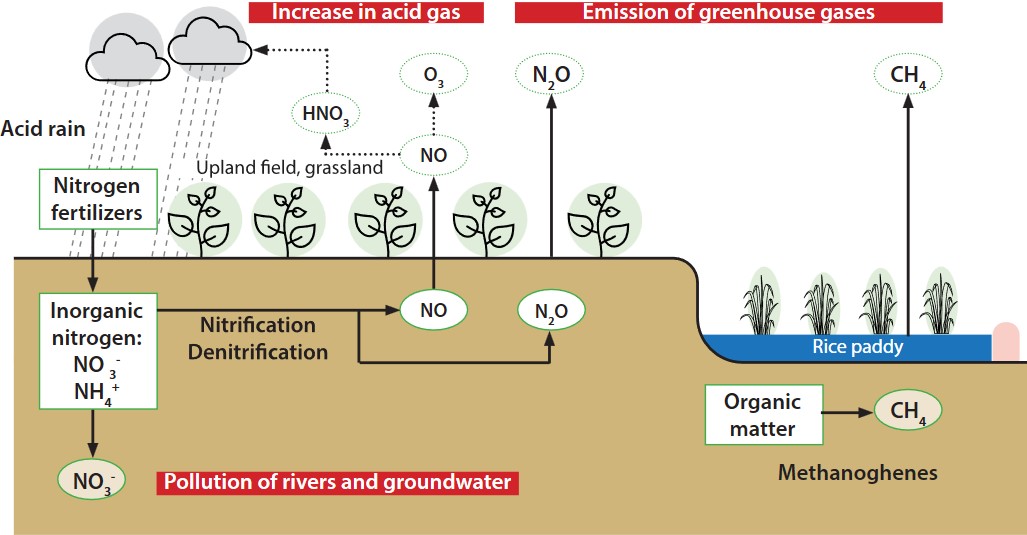
Assessments of nitrogen losses across Europe and other regions reveal widespread groundwater contamination and atmospheric emissions, highlighting gaps in current nitrogen management practices and the designation of Nitrate Vulnerable Zones (NVZs). These findings underscore the urgent need for more precise, efficient, and environmentally responsible nitrogen management strategies.
Why Inhibitors (NIs) and SRFs Often Fall Short of Crop Demand
To reduce nitrogen losses, growers have increasingly adopted tools such as nitrification inhibitors (NIs), Urease Inhibitors (UIs) and slow-release fertilizers (SRFs). While these solutions can partially mitigate leaching, they often lack sufficient control over nutrient release dynamics. Their performance is frequently influenced by soil conditions, temperature fluctuations, and rainfall patterns, limiting their ability to consistently synchronize nitrogen availability with crop demand. As a result, nitrogen losses to the environment remain a persistent challenge.
Multicote™ Technology: Synchronizing Release with Plant Uptake
Haifa Group addresses this challenge with based on its advanced Multicote™ technology. By encapsulating nutrients in a semi-permeable coating, engineered to release plant-available nitrogen at a rate governed by soil temperature, Multicote™ controlled release fertilizers (CRFs) ensure a predictable and gradual nutrient supply that closely follows crop uptake throughout the growing season.
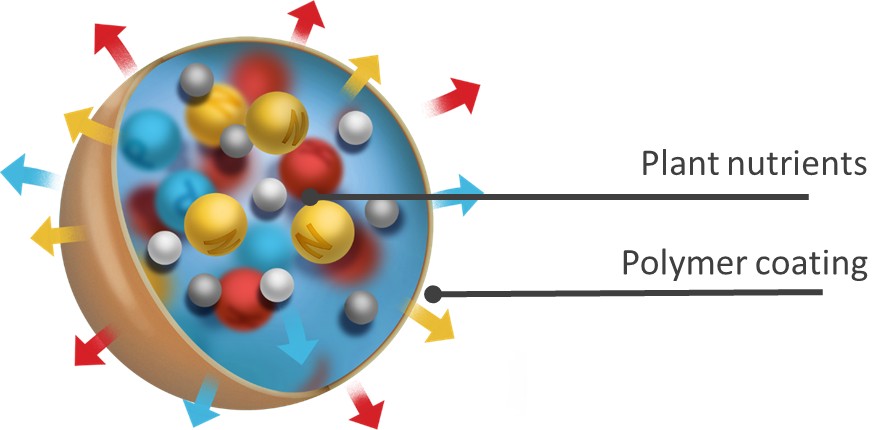
This precision-driven approach delivers multiple agronomic and environmental benefits:
- Significantly improved Nutrient Use Efficiency (NUE)
- Reduced nitrogen application rates, often by 30–50%
- Substantial reduction in nitrate leaching and nitrogen losses
- Lower greenhouse gas emissions associated with nitrogen fertilization
- Strong economic returns and high returns on investment for growers
Proven Performance: 23% Higher Yields with 40% Less Nitrogen and Less Pollution
Haifa field trials consistently demonstrate the positive impact of controlled release nitrogen, showing:
- Up to 40% reduction in nitrogen use
- Yield increases of 10–23%
- A markedly lower environmental footprint compared with conventional fertilization practices
For example, the figure hereunder compares nitrate concentrations resulting from CRF and liquid fertilization in a garlic field, measured at a soil depth of 20 cm, clearly demonstrating reduced nitrate movement under CRF application.
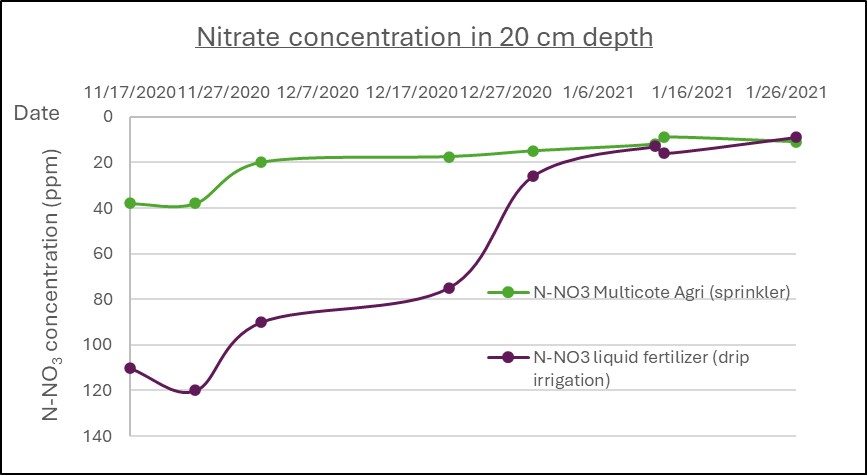
By supplying nitrogen only when and where plants can absorb it, controlled release fertilizers minimize excess nitrate in the soil solution and effectively protect groundwater resources.
The following figure illustrates ammonia volatilization resulting from conventional fertilization (granular urea) compared with controlled-release urea, highlighting the additional environmental advantages of CRF technology.
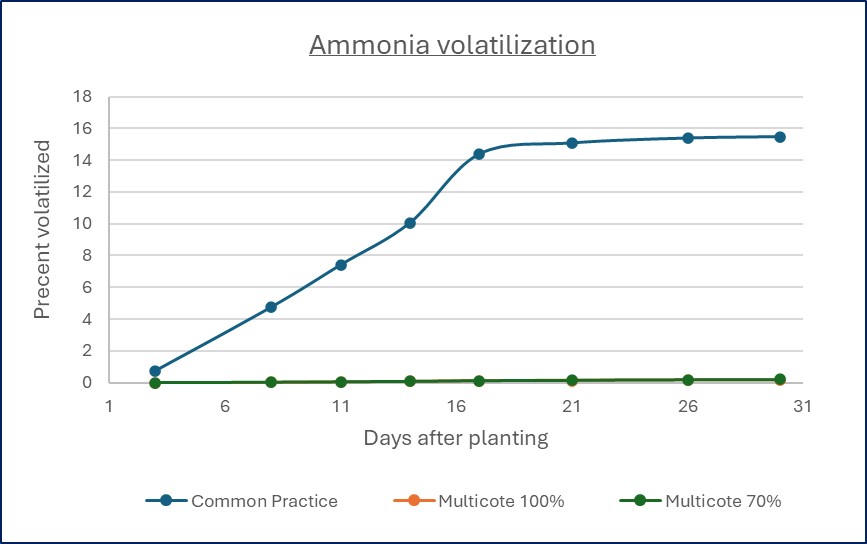
A practical meaning is that each hectare fertilized with CoteN™ instead of conventional practice is equivalent to the removal of two cars from the road! See the calculation.
Navigating the EU Nitrates Directive and NVZ Compliance
Worldwide, environmental regulations governing nitrogen use are becoming increasingly stringent. In the European Union, the Nitrates Directive (91/676/EEC) sets strict limits on nitrogen application rates and mandates best management practices within Nitrate Vulnerable Zones. Similar regulatory frameworks exist in the United States and other regions, all aimed at safeguarding water quality and public health.
Controlled-release fertilizers play a key role in helping growers comply with these regulations by reducing nitrate losses at the source, rather than relying solely on post-application mitigation measures.
Haifa Group actively promotes CRF-based solutions as part of an integrated strategy for sustainable agriculture, aligned with both regulatory requirements and global environmental objectives.
MultiMatch™: Digital Modeling for Sustainable Nitrogen Plans
To further enhance the effectiveness of CRFs, Haifa Group integrates its technology with MultiMatch™, a web-based decision-support tool. MultiMatch™ enables the design of tailored fertilization programs by accounting for:
- Soil type and texture
- Irrigation regime and water availability
- Crop-specific nutrient demand
- Temperature patterns and rooting depth
This data-driven approach ensures optimal synchronization between nutrient release and plant uptake, maximizing agronomic performance while further reducing environmental risks. A dedicated MultiMatch™ feature calculates the environmental footprint of a planned controlled-release fertilization program and compares it with conventional alternatives, supporting informed decisions that benefit both crop performance and the environment.
The Controlled Release Advantage: Precision Nutrient Delivery for Modern Farming
For Haifa Group and its partners, smart nitrogen management is more than regulatory compliance – it is a commitment to leadership in sustainable agriculture. By combining controlled-release technology with digital precision tools, Haifa empowers growers to:
- Protect groundwater and sensitive ecosystems
- Achieve higher and more consistent crop performance
- Reduce nitrogen losses and greenhouse gas emissions
- Maintain strong economic viability under tightening regulations
Smart nitrogen management with CRFs is not just a technical advancement – it is a practical pathway toward efficient, responsible, and future-ready agriculture.