






Nutritional requirements vary greatly among citrus varieties: some are sensitive to excessive fertilization (especially nitrogen) and to deficiencies of calcium, phosphorus, and potassium, while others are less sensitive and show deficiency or excess symptoms only under extreme fertilization regimes.
Main functions of plant nutrients
Nitrogen (N)
Nitrogen is one of the primary nutrients absorbed by citrus roots, preferably in form of nitrate anion (NO3 -). It is a constituent of amino acids, amides, proteins, nucleic acids, nucleotides and coenzymes, hexosamines, etc. This nutrient is equally essential for good cell division, growth and respiration.
Phosphorus (P)
Phosphorus is a component of sugar phosphates, nucleic acids, nucleotides, coenzymes, phospholipids, phytic acid, and others. It plays a key role in the reactions involving ATP. The element is necessary for many life processes such as photosynthesis, synthesis and breakdown of carbohydrates, and the transfer of energy within the plant. It helps store and use energy from photosynthesis to form seeds, develop roots, speed-up the maturity, and resist stresses.
Potassium (K)
Potassium plays a central role in plant physiology, functioning as a cofactor for over 40 enzymes and supporting numerous essential processes. It is involved in sugar and starch formation, protein synthesis, and cell growth and division. Potassium also contributes to the neutralization of organic acids and regulates carbon dioxide uptake by controlling stomatal opening, thereby improving photosynthetic efficiency and sugar utilization. In addition, it enhances plant resilience to environmental stresses, such as frost, by reducing the osmotic potential of cell sap.
Potassium is critical for plant tolerance to drought and salinity. It contributes to maintaining a higher ratio of unsaturated to saturated fatty acids in cell membranes, supporting membrane stability under stress conditions. Furthermore, potassium regulates internal water balance and cell turgidity, and plays a key role in controlling sodium (Na⁺) transport at the root cell plasmalemma. Through selective uptake mechanisms, it promotes potassium over sodium absorption and supports chloride exclusion.
K2O g/tree | Fruit weight g | Yield Kg/tree | Juice % | TSS % | Acidity % |
0 | 165.2 | 31.9 | 46.3 | 9.77 | 0.549 |
200 | 173.1 | 36.2 | 47.2 | 9.89 | 0.542 |
400 | 178.0 | 37.5 | 47.2 | 10.06 | 0.533 |
Potassium plays a key role in determining citrus peel quality. Regulating cell turgor and water balance, it contributes to peel firmness, elasticity, and resistance to mechanical damage. Adequate potassium supports uniform peel development and optimal thickness, reducing the risk of disorders such as creasing, cracking, and rind breakdown. Potassium deficiency might lead to thin, weak peel and increased susceptibility to damage, but balance is crucial, as excessive potassium may interfere with calcium and magnesium uptake, indirectly impairing peel quality.
Calcium (Ca)
Calcium plays a fundamental role in plant structure and development, and is particularly critical for fruit quality. It is a key constituent of the middle lamella of cell walls, where it forms calcium pectate, providing structural integrity and strengthening cell adhesion. This function is essential for maintaining fruit firmness, reducing susceptibility to mechanical damage, and extending shelf life.
In addition to its structural role, calcium acts as a cofactor for enzymes involved in the hydrolysis of ATP and phospholipids, supporting vital metabolic processes. It is also essential for root development and proper root functioning, contributing to efficient water and nutrient uptake. Calcium plays a role in chromosome stability and cell division, ensuring normal growth and tissue development.
Magnesium (Mg)
Magnesium is a central component of the chlorophyll molecule and is therefore essential for photosynthesis. It plays a key role in carbohydrate metabolism and the synthesis of nucleic acids, supporting overall plant growth and energy production.
Magnesium also facilitates the transport of carbohydrates from the leaves to other parts of the plant, contributing to efficient distribution of assimilates. In addition, it stimulates phosphorus uptake and transport within the plant.
A wide range of enzymes – particularly those involved in phosphate transfer reactions – require magnesium as a cofactor, making it an important activator in many metabolic processes.
Micronutrients
Although required in trace amounts, iron (Fe), copper (Cu), zinc (Zn), manganese (Mn), boron (B), and molybdenum (Mo) are essential for healthy plant growth, reproduction, and fruit development. They play key roles in enzyme activation, photosynthesis, sugar transport, cell division, hormone synthesis, and other vital physiological processes.
Nutrient deficiencies in citrus orchards - symptoms and solutions
Nutrient requirements of citrus trees
Removal of mineral elements in the harvested fruit is one of the major considerations in formulating fertilizer recommendations. The tables below show nutrient quantities removed by metric ton of fresh fruit. The large amounts of K reflect the high K content of citrus juice.
| grams per ton of fresh fruit | |||||
| N | P2O5 | K2O | MgO | CaO | |
| Orange | 1773 | 506 | 3194 | 367 | 1009 |
| Tangerine | 1532 | 376 | 2465 | 184 | 706 |
| Lemon and lime | 1638 | 366 | 2086 | 209 | 658 |
| Grapefruit | 1058 | 298 | 2422 | 183 | 573 |
| grams per ton of fresh fruit | |||||
| Fe | Mn | Zn | Cu | B | |
| Orange | 3.0 | 0.8 | 1.4 | 0.6 | 2.8 |
| Tangerine | 2.6 | 0.4 | 0.8 | 0.6 | 1.3 |
| Lemon and lime | 2.1 | 0.4 | 0.7 | 0.3 | 0.5 |
| Grapefruit | 3.0 | 0.4 | 0.7 | 0.5 | 1.6 |
Tuning nutrition according to leaf analysis
Nutrient concentrations in leaves can be used to fine-tune fertilization programs, helping to correct deficiencies and avoid excesses. Typically, samples are taken from healthy spring flush leaves that are 4–6 months old, collected from non-fruiting shoots. Selected leaves should represent average leaf size and overall tree condition. In practice, 75–100 leaves sampled from a uniform 5-hectare citrus block are sufficient for reliable analysis.
In some countries, it is recommended to sample spring-grown leaves from bearing shoots, specifically those closest to the fruit.
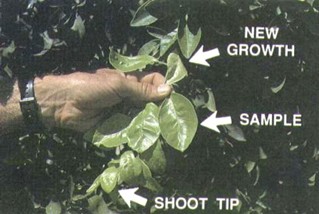
The table below refers to spring flush leaves, 4–6 months old, collected from non-fruiting terminals. It is important to note that leaves from fruiting terminals (commonly used in South Africa and some South American countries) typically contain lower levels of N, P, and K, and higher levels of Ca and Mg compared to leaves of the same age from non-fruiting terminals. This difference should be taken into account when interpreting leaf analysis results.
| Nutrient | Type of Citrus | Low (%) | Good (%) | High (%) |
| N | Naval | < 2.00 | 2.20 - 2.60 | > 2.80 |
Valencia | < 1.90 | 2.10 - 2.40 | > 2.70 | |
Grapefruit | < 1.60 | 1.80 - 2.40 | > 2.60 | |
| P | Naval | < 0.09 | 0.11 - 0.16 | > 0.19 |
Valencia | < 0.09 | 0.11 - 0.16 | > 0.19 | |
Grapefruit | < 0.10 | 0.13 - 0.17 | > 0.20 | |
| K | Naval | < 0.60 | 0.70 - 1.70 | > 1.80 |
Valencia | < 0.70 | 0.90 - 1.80 | > 1.80 | |
Grapefruit | < 0.50 | 0.70 - 1.70 | > 1.80 |
It should be noted that using leaf analysis to adjust fertilization in citrus is not always straightforward. Sampling is conducted well before harvest, while fruit load has a significant influence on nutrient concentrations. Leaves function as a “buffer reservoir” for developing fruit: under high fruit load, nutrient concentrations in leaves tend to decrease, whereas under low fruit load, they tend to increase.
Nevertheless, leaf analysis remains an important tool, particularly for monitoring nutrients that are not regularly supplied through fertilization programs, ensuring that deficiencies do not develop. Monitoring micronutrients is especially important, given their essential role in maintaining proper leaf function and overall plant health.
Nutrient Deficiency Symptoms in Citrus
Nutrient deficiency symptoms can appear in different parts of the plant, most commonly in leaves, but also in fruits and roots. An important factor influencing symptom expression is nutrient mobility within the plant.
Nutrients are classified according to their mobility: very mobile nutrients (such as nitrogen, phosphorus, potassium, and magnesium) can be redistributed from older to younger tissues, especially during the transition from vegetative to reproductive growth. In contrast, immobile or slightly mobile nutrients (such as calcium, boron, iron, copper, zinc, molybdenum, and sulfur) cannot be readily relocated within the plant. As a result, deficiencies of mobile nutrients typically appear first in older leaves, while deficiencies of immobile nutrients are expressed in younger leaves or developing organs, including fruits. In particular, disorders related to calcium and boron often manifest directly in fruit tissues.
The development of visible symptoms is associated with underlying metabolic disturbances, which begin at the cellular and micro-morphological level before becoming externally visible. The pattern and location of symptom expression – whether on young or old leaves, or on fruits – provide valuable diagnostic clues for identifying the specific nutrient imbalance.
Both nutrient deficiency and excess can reduce crop yield and impair fruit quality. In some citrus varieties, mild deficiency symptoms may be tolerated without significant yield loss, while in others, even slight imbalances can have a substantial impact.
Common deficiency symptoms include:
General stunting or reduced plant growth, sometimes accompanied by loss of normal green coloration or lighter-colored young leaves
Development of purple coloration in older leaves, often more pronounced on the underside
Chlorosis, either interveinal or across the entire leaf, appearing on young leaves, older leaves, or both
Necrosis at leaf margins, between veins, or across the entire leaf surface
Stunted terminal growth, expressed as rosetting, “frenching,” or reduced leaf size, sometimes followed by dieback of growing points
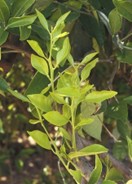
Pale new growth - a typical sign of nitrogen deficiency 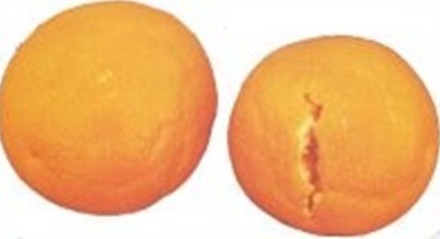
Fruits creasing indicates calcium deficiency Learn about nutrient deficiencies in citrus orchards - symptoms and solutions