
Nutritional disorders in citrus reduce growth, yield, and fruit quality. Identifying deficiency symptoms and applying the right nutritional solutions helps ensure optimal performance of the orchard.
Nutritional Disorders in Citrus
Nitrogen (N)
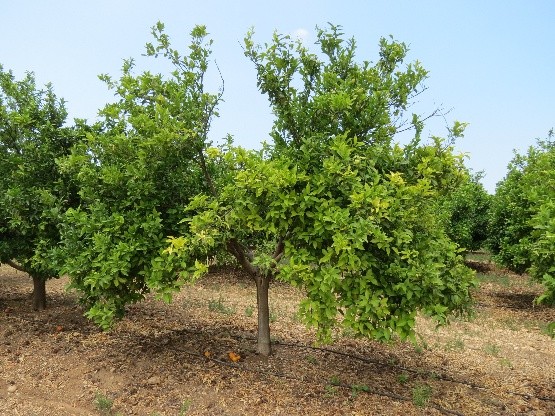
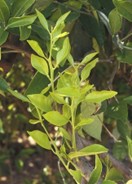
Typical deficiency symptoms: Nitrogen deficiency is typically expressed as a uniform light green to yellow discoloration across the entire tree canopy. Under mild deficiency, foliage appears pale green and gradually turns yellow as the condition becomes more severe. New growth often emerges light green but may darken as leaves expand and mature, particularly if nitrogen supply improves.
As deficiency progresses, older leaves may senesce prematurely, developing a yellow to bronze coloration prior to abscission. Prolonged nitrogen deficiency leads to reduced vegetative growth, lower fruit set, and decreased yield.
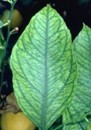
In some cases, a specific form of chlorosis – yellow vein chlorosis – may develop, where the midrib and lateral veins turn yellow while the surrounding leaf tissue remains green. This is often associated with girdling of branches or the trunk, but may also occur during cooler periods in autumn and winter, when nitrogen uptake from the soil is reduced.
Note: excessive nitrogen application promotes vigorous vegetative growth at the expense of fruit production, often resulting in poorer fruit quality.
 |  |
Haifa solutions: Multicote™ Agri
Phosphorus (P)
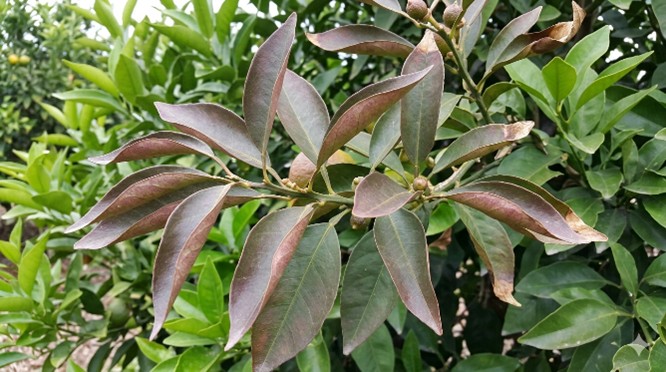
Typical phosphorus deficiency symptoms include dull, lusterless foliage with a loss of the normal deep green color. Leaves become smaller and narrower, often developing a purplish or bronze discoloration. As the condition progresses, some leaves may develop necrotic areas, while overall plant growth slows and young leaves show reduced development.
These symptoms are typically observed first on older leaves, as phosphorus is a mobile nutrient that is translocated from older tissues to younger, actively growing parts of the plant.
Fruit quality is also affected: fruits tend to be coarse, with thicker rinds, lower juice content, and higher acidity.
Haifa solutions: Haifa MAP™, Haifa MKP™, Haifa ProteK™
Potassium (K)
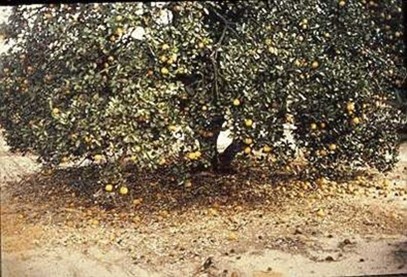
Potassium deficiency is typically expressed at early stages as stunted growth, sparse foliage with a slight bronze tint, and a generally dull, lusterless leaf appearance. As the deficiency progresses, chlorophyll degradation becomes evident, appearing as pale-yellow blotches on the distal half of the leaf. These blotches gradually deepen to a bronze color, spreading and coalescing, while leaf tips may turn brown. Older leaves often exhibit yellow to yellow-bronze chlorosis, sometimes accompanied by corky veins and variegated patterns.
Under severe deficiency, leaves may wrinkle, twist, or curl – often downward in a screw-like pattern, particularly in lemon. New lateral shoot development is weak due to reduced mechanical strength, and shoots may develop a characteristic S-shaped growth pattern.
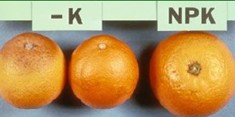
Fruit development is also significantly affected. Fruit tends to be smaller, with thin, smooth peels, and may drop prematurely. In some cases, fruit growth becomes elongated, resulting in an elliptical shape due to restricted equatorial development.
Potassium deficiency is more likely to occur in calcareous soils due to nutrient antagonism, and in orchards with high fruit load combined with excessive nitrogen application.
| 
| 
|
Haifa solutions: Multi-K™, Haifa Bonus™, Poly-Feed™ Foliar, Poly-Feed™ Drip
Calcium (Ca)
Calcium deficiency is primarily expressed through chlorosis along the leaf margins and between the main veins, often more pronounced during cooler periods. As the condition progresses, small necrotic (dead) spots develop within the chlorotic areas. Leaves may become small, thickened, and misshapen, and in severe cases, foliage density declines due to premature leaf drop.
Growth is significantly affected: roots are poorly developed and may begin to decay, while shoots exhibit dieback and overall tree vigor declines, resulting in stunted growth. Multiple bud break may occur, producing weak new shoots.
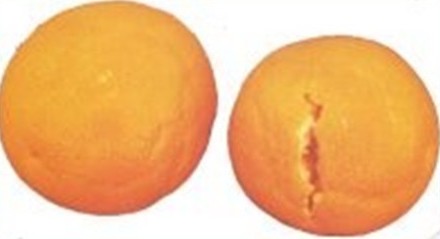
Fruit quality is particularly sensitive to calcium deficiency. Fruits are often undersized and misshapen, with shriveled juice vesicles. In advanced stages, rind disorders may develop, including creasing, cracking beneath the peel, splitting, and separation of the rind.
Haifa solutions: Haifa Cal™, HaifaStim™ Calmaster
Magnesium (Mg)
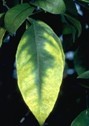
Initial symptoms of magnesium deficiency include irregular yellow blotches near the base of the leaf along the midrib, especially on leaves close to fruit. These blotches gradually enlarge and merge, forming a broad yellow area on both sides of the midrib, while the leaf tip and base remain green – creating a characteristic inverted V-shaped pattern. These symptoms typically appear on mature leaves, as magnesium is remobilized to support fruit development.
As the deficiency progresses, leaves may turn entirely yellow to bronze and eventually drop. Symptoms are more pronounced on heavily fruiting branches, which may become partially or completely defoliated, while lightly fruited branches may show little or no symptoms. Seeded cultivars are generally more affected than seedless ones.
Magnesium deficiency is more common in calcareous soils and may require correction through foliar applications.
Haifa solutions: Haifa Mag™, BitterMag™
Sulfur (S)
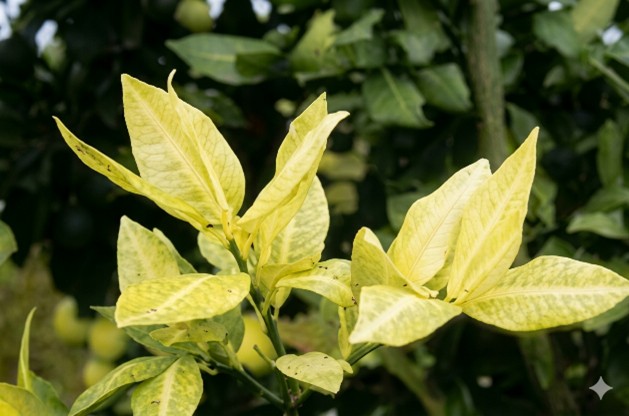
The classical symptom of sulfur deficiency is uniform yellowing of younger leaves, while older leaves remain green, reflecting the low mobility of sulfur within the plant. Sulfur deficiency may be confused with nitrogen deficiency; however, this can be reliably distinguished through leaf analysis.
At the fruit level, deficiency may result in undersized and misshapen fruits.
Haifa solutions: Haifa SOP™, Ammonium Sulfate
Iron (Fe)
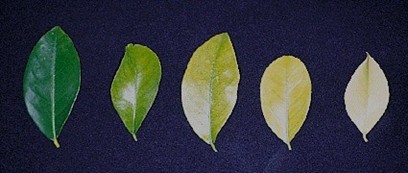
Iron (Fe) deficiency is typically expressed as interveinal chlorosis on young leaves, due to the immobility of iron within the plant. In mild cases, leaf veins remain slightly darker green than the interveinal areas, creating a distinct contrast that appears first on newly emerged foliage.
As the deficiency progresses, the interveinal areas turn increasingly yellow, eventually becoming pale yellow to almost ivory in color. New leaves are often smaller than normal. In severe cases, leaves may become completely bleached, with scorched margins and tips. Affected leaves are typically thin, fragile, and prone to premature drop.
At the canopy level, deficiency leads to reduced vigor, with dieback starting from the outer and upper parts of the tree. In advanced stages, trees may exhibit partial defoliation, twig dieback, and even dead tops, while lower limbs may temporarily retain relatively normal foliage.
Iron deficiency is commonly associated with calcareous soils and high pH conditions, which limit iron availability. It is more likely to occur on sensitive rootstocks such as Swingle citrumelo. Similar symptoms may also appear under conditions of root stress, such as waterlogging (flooding damage), or in cases of copper toxicity, and should therefore be carefully diagnosed.
| 
|
Haifa solutions: Haifa Micro™ Fe 13, HaiFer™, Haifa Micro™ Top Iron
Zinc (Zn)
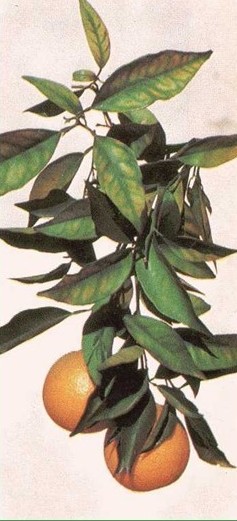
Initial symptoms of zinc deficiency include irregular green bands along the midrib and main veins, set against a light yellow to nearly white background. The proportion of green to chlorotic tissue varies with severity: in mild deficiency, small yellow blotches appear between the larger lateral veins, while in more advanced stages, only a narrow basal portion of the midrib remains green and the rest of the leaf becomes pale yellow to white.
As the deficiency intensifies, leaves become abnormally small, narrow, and pointed, often standing upright. Rosetting develops due to shortened internodes, and overall shoot growth is reduced. Twigs become thin and weak and may eventually die back. In advanced cases, symptoms spread throughout the canopy, often accompanied by profuse development of water sprouts.
As the deficiency intensifies, leaves become abnormally small, narrow, and pointed, often standing upright. Rosetting develops due to shortened internodes, and overall shoot growth is reduced. Twigs become thin and weak and may eventually die back. In advanced cases, symptoms spread throughout the canopy, often accompanied by profuse development of water sprouts.
Haifa solutions: Haifa Micro™ Zn 15
Manganese (Mn)
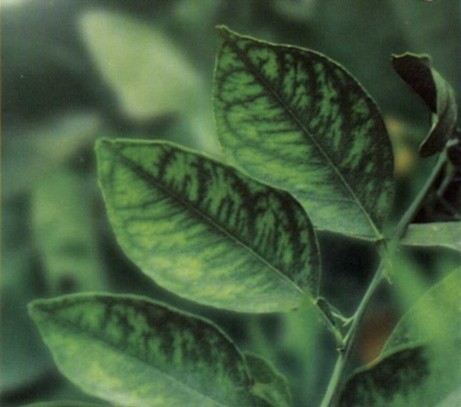
Manganese (Mn) deficiency is typically expressed as interveinal chlorosis on young leaves, while narrow dark green bands remain along the midrib and main veins, giving the foliage a mottled appearance. Young leaves often show a fine network of green veins on a lighter green background, although this pattern is usually less distinct than in zinc or iron deficiencies.
As the deficiency progresses, leaves may become dull green to yellowish-green, with the veins losing their intensity and appearing pale. Symptoms may gradually extend to older leaves. In affected trees, stems often appear yellowish-green and may become hard and woody.
Manganese deficiency commonly occurs in calcareous soils and may be more pronounced on trees grafted onto pH-sensitive rootstocks. It can sometimes resemble zinc deficiency, and both deficiencies may occur simultaneously. In early stages, symptoms may be transient and disappear as the season progresses; therefore, repeated observation is recommended before taking corrective action.
Manganese deficiency commonly occurs in calcareous soils and may be more pronounced on trees grafted onto pH-sensitive rootstocks. It can sometimes resemble zinc deficiency, and both deficiencies may occur simultaneously. In early stages, symptoms may be transient and disappear as the season progresses; therefore, repeated observation is recommended before taking corrective action..
Haifa solutions: Haifa Micro™ Mn 13
Copper (Cu)
Early symptoms of copper (Cu) deficiency include wilting of terminal shoots, often followed by leaf death.
In mild cases, the deficiency is associated with large, dark green leaves borne on long, soft, angular shoots. Young shoots may curve into an S-shape. Twigs may develop blister-like pockets of clear gum at the nodes, and as they mature, reddish-brown eruptions may appear in the outer wood.
As the deficiency progresses, twigs typically die back from the tips, while new growth may emerge as multiple buds, forming a characteristic “witches’ broom” appearance. In severe cases, fruit may develop necrotic, corky lesions on the surface.
Copper deficiency is more likely to occur in young orchards established on previously uncultivated soils, which are often low in copper. It may also be induced or aggravated by excessive nitrogen fertilization.
Haifa solutions: Haifa Micro™ Cu 15
Boron (B)
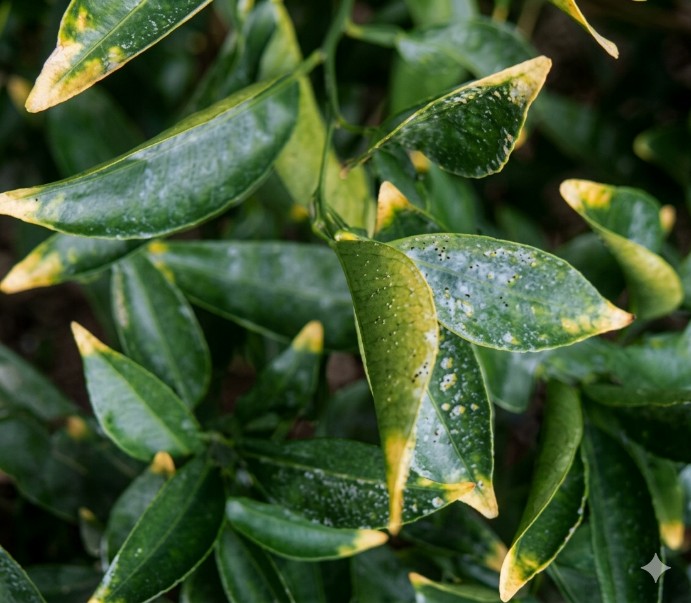
Fruit symptoms most indicative of boron deficiency include darkish-colored spots in the white albedo of fruit and sometimes in the central core. Fruits are small and may be somewhat misshaped with a lumpy surface. Young leaves are dull brown/green, and water-soaked areas may develop. Leaves are thick, curled with pronounced veins on upper surface. Bark of twigs may split.
Haifa solution: Haifa Micro™ Bor-feed
Note: Boron fertilization must be managed carefully, as excess can cause toxicity.
Molybdenum (Mo)
Haifa solutions: Haifa Micro™ Combi