





Grape vines require a balanced supply of nutrients to sustain their complex growth cycle, from bud break through berry ripening and into post-harvest recovery. At each stage, precise nutrient management is essential to support physiological processes and address specific sensitivities. This article outlines the role of key nutrients in grapevine development and yield formation and provides fundamentals for planning effective annual nutrition programs.
Main functions of plant nutrients
Nitrogen (N)
Nitrogen drives vegetative growth, including shoot elongation, leaf expansion, and berry sizing. When selecting nitrogen fertilizers, attention should be given to the form they contain:
- Ureic nitrogen (N-NH2) is suitable for medium to heavy soils and moderate to high temperatures.
- Nitrate nitrogen (N-NO3) is readily available for uptake and is generally preferred, though prone to leaching.
- Ammoniacal nitrogen (N-NH4) in excess may damage roots.
- Soil organic nitrogen from residues, compost, or manure can significantly contribute to requirements and must be factored into planning.
Phosphorus (P)
Phosphorus is fundamental for energy transfer and is a key component of DNA and RNA, making it indispensable for all plant processes. Adequate supply is essential, especially at the beginning of the growth season, to encourage root activity. Phosphorus uptake is more efficient when it is applied in combination with nitrogen. As the phosphorus uptake is an energy-consuming process, excessive uptake is not possible. However, excessive P application might interfere with uptake of iron, zinc and manganese.
Phosphorus deficiency often triggers increased root growth and organic acid excretion at the expense of canopy development.
Potassium (K)
Potassium is the dominant nutrient in berries, regulating sugar accumulation, berry size, and color. It also controls plant water relations, enzyme activation, respiration, and photosynthesis. Adequate potassium supply during fruit development is essential for proper maturation, health, and quality. Fertilizer sources include potassium chloride, potassium sulphate, and potassium nitrate. Of these, potassium nitrate is preferred, as it provides only essential nutrients and dissolves completely.
Secondary and micronutrients
Calcium (Ca) strengthens cell walls, enhances berry firmness, and prolongs post-harvest life.
Magnesium (Mg) is vital for chlorophyll synthesis and photosynthesis.
Micronutrients (Fe, Zn, Mn, B) support chlorophyll synthesis, enzyme activation, and balanced berry development.
Nutrient requirements
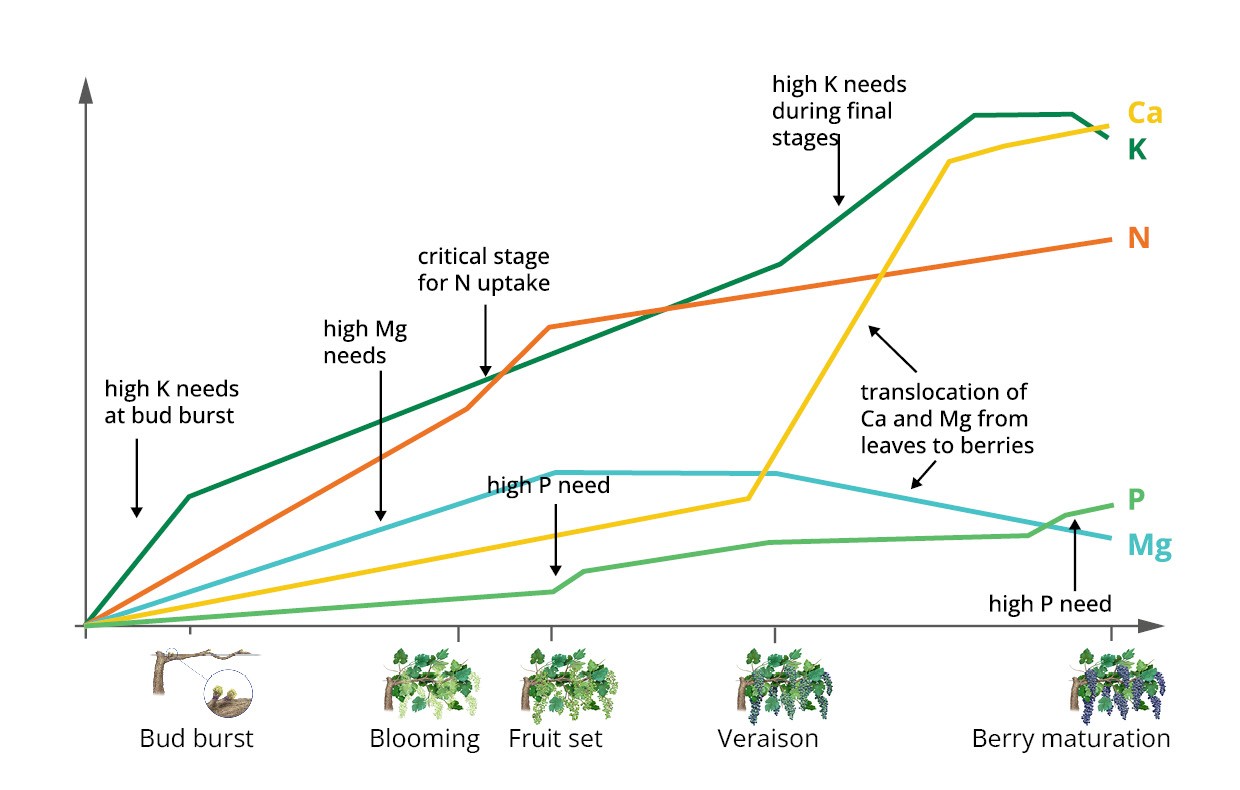
Nutrient uptake in vineyards varies by growth stage, reflecting the physiological processes occurring at each phase:
- Pre-flowering to fruit set: demand peaks for nitrogen and phosphorus to support canopy establishment and berry initiation.
- Berry growth and veraison: potassium demand sharply increases, while magnesium and calcium remain critical to berry quality.
- Post-harvest: balanced nutrition ensures proper carbohydrate storage and supports next season’s fertility.
Typical distribution of nutrient requirements throughout the season:
Stage | N (kg/ha) | P2O5 (kg/ha) | K2O (kg/ha) |
From bud break to fruit set | 40 | 20 | 60 |
Berry growth and veraison | 20 | - | 70 |
Post-harvest | 20 | 10 | 50 |
Typical requirements of macronutrients for a yield of 20 tons/ha include: 80–100 kg/ha N, 20–30 kg/ha P2O5, and 120–160 kg/ha K2O. Calcium and magnesium application rates strongly depend on the irrigation water quality.
See examples of detailed nutritional programs
Table Grapes vs. Wine Grapes
In short: the nutrition of table grapes aims to maximize yield and fruit size, while the nutrition of wine grapes focuses on optimizing quality parameters. Fertilization rates for wine grapes are significantly lower – sometimes intentionally limited to “stress” the vines and enhance fruit composition.
In table grape vineyards, nutrition programs are designed to promote vigorous growth and high yields, with ample applications of nitrogen and potassium throughout the season until shortly before harvest. Additional fertilization is often applied post-harvest to replenish nutrient reserves for the following season.
In wine grape vineyards, by contrast, fertilization is modest and carefully measured to prevent excessive growth. The goal is to achieve a balanced vine that produces berries with optimal sugar concentration and the complex compounds that define wine flavor and aroma.
Monitoring Nutrient Status
Regular monitoring is essential to adjust nutrition programs and precisely meet the plant needs throughout the season. Because grapevine roots grow deep, leaf and petiole analysis are more significant than soil analysis.
At least two analyses during the season are recommended: at full bloom and berry maturation (14-21o Brix).
Desired nutrient concentrations:
Nutrient | % of dry matter in petioles | % of dry matter in leaves |
N | 0.8 – 1.50 | 1.5 – 3.50 |
P | 0.2 – 0.32 | 0.26 – 0.60 |
K | 1.5 – 2.5 | 1.5 – 2.5 |
Ca | 1.5 – 3.0 | 1.5 – 3.0 |
Mg | 0.3 – 0.8 | 0.3 – 0.8 |
S | 0.08 – 0.12 | 0.15 – 0.35 |
Fe | 15 – 75 | 40 – 100 |
Mn | 35 – 100 | 35 – 100 |
Zn | 25 – 50 | 25 – 40 |
Cu | 10 – 30 | 10 – 30 |
B | 25 – 40 | 30 – 50 |
Note: values vary according to varieties and root stocks.
Tracking nutrient status across seasons helps detect trends, as deficiencies often develop long before visible symptoms appear.
Adjust programs accordingly, considering growth vigor, flowering, fruit set, and yield.
Nutritional disorders in grapevines
Nitrogen deficiency results in retarded growth, poor flowering and fruit set, smaller berries and yield loss.
Nitrogen excess retards fruit maturation and decreases fruit quality. It also gives rise to vulnerability to biotic attacks.
Typical symptoms of phosphorus deficiency are darkening or bronzing leaves, that may also become brittle, small leaves, poor flowering and increased drop of flowers and fruitlets, and delayed ripening.
Deficiency is likely to occur in soils with high lime content, in sandy soil and in hilly areas with shallow soils.
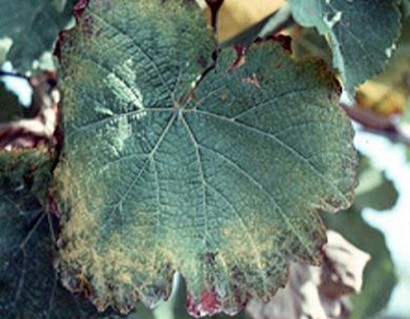
Potassium deficiency is manifested by chlorosis of leaf margins in older leaves, fruit softening and increased vulnerability to diseases and insect attacks.
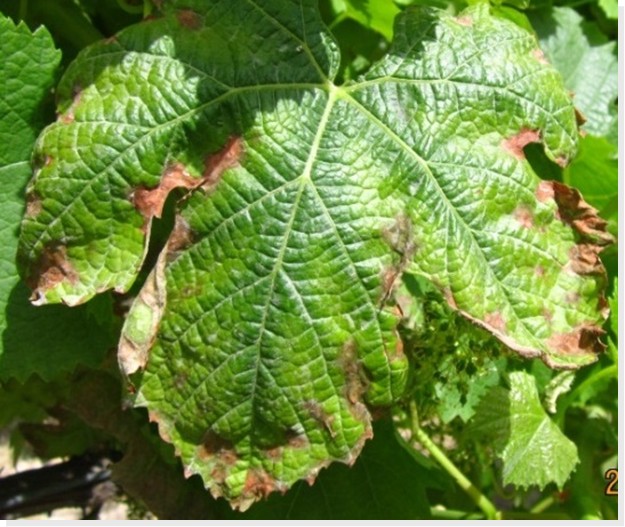
See here pictures and descriptions of other nutrient deficiencies in vineyards.
Salinity management
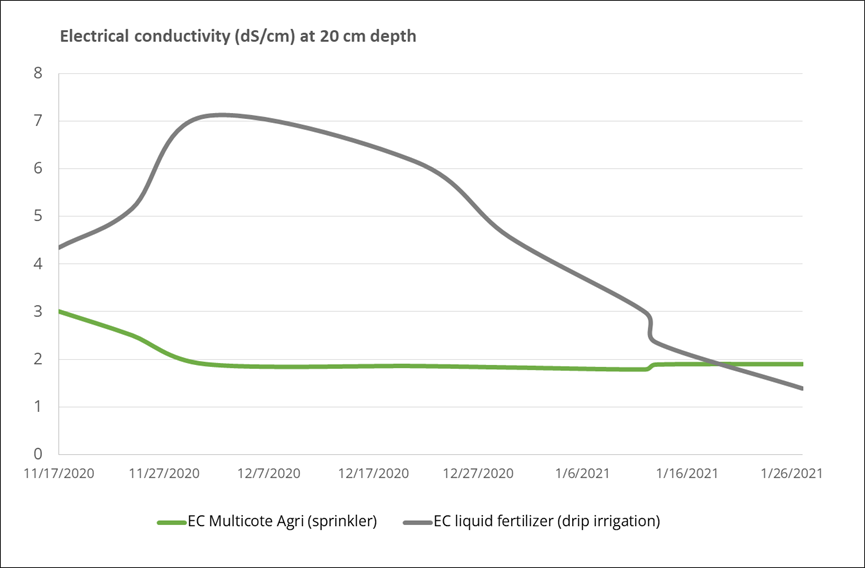
Grapes are moderately sensitive to salinity. Yields decline once irrigation water exceeds 2.5 dS/m (≈10% reduction), with losses of 25–50% at 4.1–6.7 dS/m. Symptoms include leaf burn, stunted growth, berry cracking, and higher disease susceptibility.
Management strategies:
- Use chloride-free fertilizers.
- Apply controlled-release solutions such as Multicote™ Agri, which helps prevent salt buildup in the root zone (see graph below).