



Sustained Nutrition Drives Nutrient Use Efficiency and Yield Stability Under Field Conditions
 Efficient nitrogen management is a key factor determining yield, profitability, and environmental impact in agricultural crop production. For this reason, continuous efforts are made to evaluate and optimize nitrogen fertilization strategies. A field trial conducted at the LandLab trial station in Quinto Vicentino, Italy, evaluated different nitrogen fertilization protocols and clearly demonstrated that Multicote Agri™ controlled-release fertilizers deliver superior nitrogen use efficiency compared with conventional mineral fertilization, resulting in higher and more stable yields under variable weather conditions, while also allowing reduced fertilizer application rates. This gave the grower an exceptional ROI ratio of 8:1.
Trial Overview
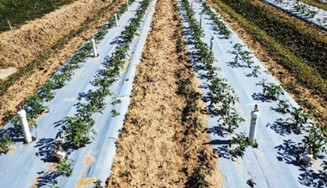
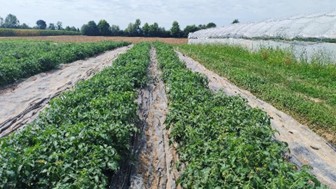
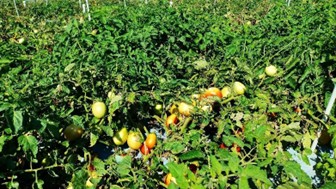
The trial was carried out in open-field processing tomatoes over the 2025 growing season.
Crop: Tomato (Solanum lycopersicum, var. UG RED squared), grown under plastic mulch
Density: 33,000 plants/ha
Planting date: June 10
Harvest date: September 8
Soil type: Silty loam
The trial followed a randomized complete block design, with four replicates per treatment and plot size of 13 m².
 |  |  |
Fertilization Treatments
# | Treatment | N rate (kg/ha) | No of applications |
1 | Multicote™ Agri 50% N | 101 | 1 |
2 | Multicote™ Agri 75% N | 150 | 1 |
3 | Multicote™ Agri 100% N | 200 | 1 |
4 | Multicote™ Agri 125% N | 250 | 1 |
5 | Multicote™ Agri 150% N | 300 | 1 |
6 | Conventional 50% N | 100 | 2 |
7 | Conventional 75% N | 150 | 2 |
8 | Conventional 100% N | 200 | 2 |
9 | Conventional 125% N | 250 | 2 |
10 | Conventional 150% N | 300 | 2 |
Weather conditions
The season was characterized by above-average rainfall, with a total of 556.9 mm and 15 days receiving more than 5 mm of precipitation. Such conditions increased the risk of nitrogen leaching, particularly in the mineral fertilization programs.
In addition, a high-temperature event in mid-June (>35 °C) likely interfered with fruit setting, further emphasizing the importance of stable nutrient availability during sensitive growth stages.
Results and Discussion
Across all nitrogen rates, CRF-based programs consistently outperformed mineral fertilization in total yield.
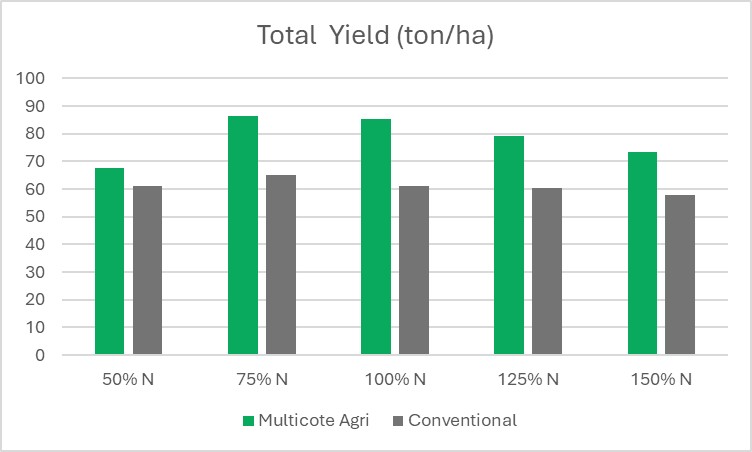
While mineral programs showed relatively flat yield responses despite increasing nitrogen inputs, Multicote™ Agri treatments followed a classic yield-response curve, with optimal performance at 75–100% of the estimated nitrogen demand.
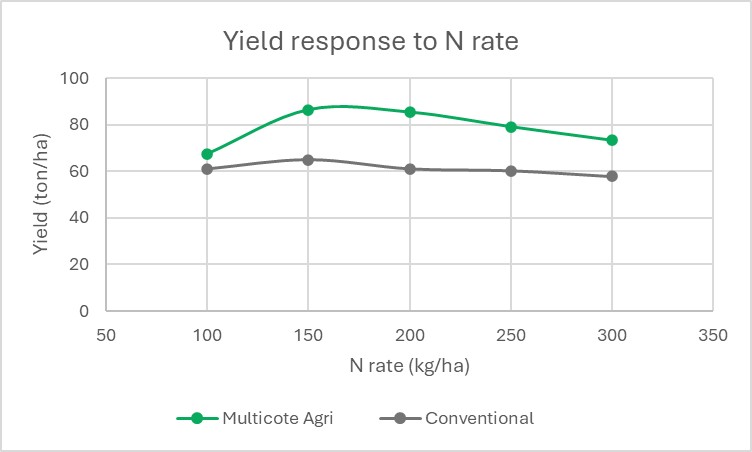
This contrast highlights a fundamental difference in nutrient use efficiency. In mineral programs, frequent and abundant rainfall during the season led to significant nitrate leaching, reducing the availability of nitrogen to the crop and flattening yield differences between treatments. In contrast, Multicote™ Agri gradually released nitrogen in sync with crop demand, maintaining nutrient availability even under leaching-prone conditions.
Economical Analysis and Grower’s Benefit
Treatment | Fertilizer cost (€/ha) | Yield (ton/ha) | Profit (€/ha) | Net benefit (€/ha) |
Multicote™ Agri 50% N | 1,092 | 67.48 | 9,616 | 8,524 |
Multicote™ Agri 75% N | 1,236 | 86.51 | 12,328 | 11,092 |
Multicote™ Agri 100% N | 1,282 | 85.44 | 12,175 | 10,893 |
Multicote™ Agri 125% N | 1,377 | 79.14 | 11,277 | 9,900 |
Multicote™ Agri 150% N | 1,473 | 73.29 | 10,444 | 8,971 |
Conventional 50% N | 566 | 61.08 | 8,704 | 8,138 |
Conventional 75% N | 642 | 64.93 | 9,253 | 8,611 |
Conventional 100% N | 698 | 61.09 | 8,705 | 8,007 |
Conventional 125% N | 755 | 60.28 | 8,590 | 7,835 |
Conventional 150% N | 811 | 57.84 | 8,242 | 7,431 |
Comparing the cost of the 75% treatments, Multicote™ Agri cost 594 €/Ha more. However, with income higher by 3,075 €/Ha, Multicote™ Agri offered net benefit higher by 2481 €/Ha and ROI ratio of 8 - for every Euro the grower invested on fertilizers, he earned back 8€!
Multicote™ Agri at 75% application rate increased net benefit by 28.8% compared to conventional fertilizer at 75%, and by 38.5% compared to conventional fertilizer at 100% application rate.
Benefit for the environment, too
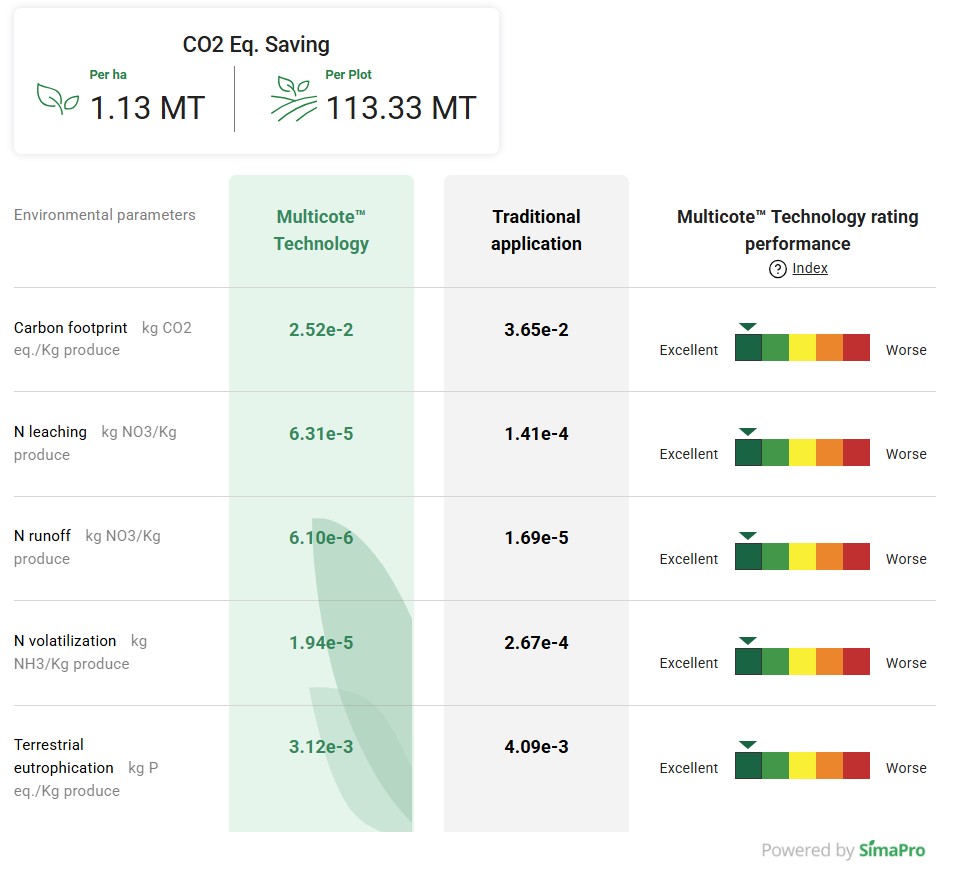
Carbon footprint calculations performed using the MultiMatch™ Carbon Footprint Calculator indicate that Multicote™ Agri application reduced greenhouse gas emissions by 1.13 ton CO₂-eq per hectare, equivalent to 25.2 kg CO₂-eq per ton of harvested yield.
Conclusions
The results clearly show that higher yields under Multicote™ Agri programs were not driven by excessive nitrogen uptake, but rather by better synchronization between nitrogen release and plant demand.
This efficient nitrogen supply allowed plants to sustain optimal nutritional status during key growth stages, supporting fruit set, fruit filling, and final yield – without the drawbacks associated with over-fertilization.
Overall, the trial confirms that controlled-release fertilizers enhance nutrient use efficiency by maintaining consistent plant nitrogen status throughout the season.
Under real open-field conditions – especially in environments prone to rainfall and leaching – Multicote™-based programs enable growers to:
Achieve higher yields with moderate nitrogen rates
Reduce nitrogen losses due to leaching
Improve nitrogen use efficiency and crop predictability
Avoid yield penalties associated with both nitrogen deficiency and excess
Contract the carbon footprint of agricultural crop production